First of all, I must admit that the greatest recreation and entertainment for me and my family is spending delightful moments in nature, enjoying beautiful landscapes, and making the most of the amazing blessings that the Almighty Creator has fashioned with the utmost artistry and beauty. This has always been a source of inspiration for artists and writers, scientists and nature lovers, and in fact, for all human beings who possess vision, thought, and reflection. And this is not limited to a specific place, time, or era—it has always been so throughout history and across the world, and it will continue to be so.
|
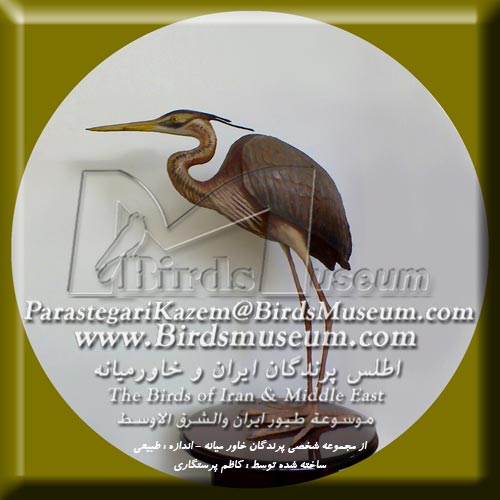
Imagine a lively, pleasant, and cheerful day with the family, right in the heart of nature, equipped with sketching tools, easel, paper, clips, pencils, a paint box, binoculars, and a camera—not to mention other necessities for a carefree day away from worries and noise, along with enough provisions. Most importantly, all five members of the group are enthusiastic and in harmony, eagerly looking for the perfect subject to capture on their sketch pad. Our rule is that a drawing of a bird, with accurate proportions and details, earns the highest score. Likewise, taking a clear photo of the bird in a beautiful pose is also highly valued. To do this, we first scout for the right spot with binoculars, then proceed with sketching and photographing the chosen subject. Soon after, a discussion begins about what the bird’s name is, what its scientific name might be, and to which class, family, or order it belongs. And since my children have done extensive studies and research in this field, we quickly arrive at the answer. After the scoring, critique, and review, we happily move on to lunch, prayers, tea, fruit, and a bit of rest. Then comes some group strolling, taking photos, and finally getting ready to return home—until our next encounter with nature, in search of another subject and another sketch. At a suitable time, we examine the sketches and photos, comparing them with the texts and illustrations in books and other available resources, and we study the full details of each bird more carefully. We then create multiple pencil sketches from different angles so that the form and structure of the bird become fully ingrained in our minds. Afterward, we put the selected sketches up for discussion and review, in order to choose the one most suitable for execution and for inclusion in the Atlas of Birds of Iran and the Middle East. It should be noted that the figure and posture of each bird are among its important species-specific characteristics and play a significant role in its identification. Therefore, choosing the right design at the very beginning is of great importance. After selecting the form, the next crucial matter is the size of the bird, since the constructed model must be exactly life-sized. At this stage, we calculate and determine all the detailed measurements—such as the length of the body, neck, legs, beak, tail, wings, and, in short, all the dimensions necessary for creating the intended volume. Based on these measurements, we prepare a wire framework (armature). The thickness of the wires is chosen in proportion to the bird’s overall size and the size of its legs. The next step is attaching two metal wires as a pair of legs at the designated position in the initial design. To ensure the bird’s balance and stability, we must precisely calculate the resultant of the acting forces so that it fully aligns with these two points. In fact, the center of gravity of the bird must be located at the position of the legs, so that the balance and posture envisioned in the design are maintained. The intention is that each bird should be able to stand on its own legs without leaning against any other object. The difficulty lies in the fact that, in most cases, the center of gravity falls outside the leg position. In such instances, by adjusting the weight of certain parts of the outer coating—made of a type of composite material that will be applied over the armature—we shift the center of gravity back to the desired point, i.e., where the legs connect. This process is made more precise through static calculations. After that, we move on to preparing a special composite material, consisting of a filler substance and a type of resin, mixed with a strong and durable adhesive. As mentioned, depending on the specific gravity required for the composite coating over the wire framework, different filler materials are used. Sometimes, to maintain balance, we may need to use metallic powders such as iron (for added weight), aluminum (for lighter weight), wood powder (most commonly), chalk, or other substances. It is important to note here that the armature must always be made slightly slimmer than the natural size of the bird, to allow room for the coating and to achieve the intended volume and shape. Once this stage is completed, we carefully compare the resulting form with the initial design and ensure that the outcome is satisfactory. Next, the obtained volume is coated with a waterproof sealant. After it dries, the eyes are set in place. In the final stage before painting, the constructed bird is smoothed and finished with putty, after which the model is ready for painting.
Up to this stage, everything that had been done required a set of technical and artistic knowledge, familiarity with materials, and, of course, drawing skills. However, in the next stage—the stage of painting—extensive knowledge of ornithology becomes essential. At this point, in addition to my own observations and studies, I benefit greatly from the help of my sons, Mohammad and Mohammad Javad, who, besides their engineering expertise in their own fields, have carried out significant studies and scientific research in this area. They are often consulted by relevant organizations in the identification and classification of bird species in the Middle East. In some cases, they themselves even take part in the painting process, and their precision and knowledge are truly commendable. Before personal computers became available, the process of constructing and identifying each bird in this collection was very difficult and demanding. Fortunately, with access to computers equipped with powerful processors and, by God’s grace, becoming familiar with the necessary programming, the process of creating and completing this collection has become somewhat easier. Nowadays, for example, determining detailed measurements and preparing the wire armature is carried out with the help of software that can generate three-dimensional models of various shapes, display them in wireframe at any desired size, and convert their scales into chosen units of length. Furthermore, the internet provides invaluable assistance in acquiring specialized information about rare and endangered birds. Most importantly, for maintaining balance and determining the specific weight of the composite materials used, we employ software that, after modeling the bird’s volume, allows us to click on any point as the center of gravity. It then generates a shaded color spectrum that shows which areas should be made with heavier materials and which with lighter ones.
|
|
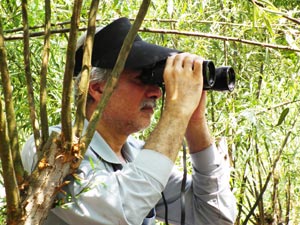 کاظم پرستگاری
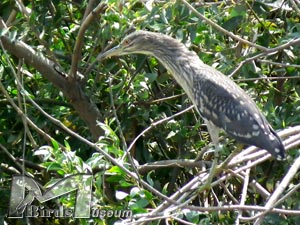 Photo by Mohammad Javad Parastegari – Black-crowned Night Heron (Juvenile) – Isfahan
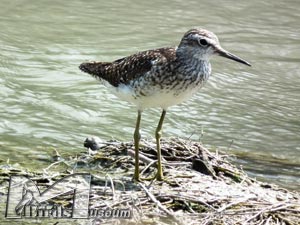 Spotted Sandpiper – Zayandeh Rud – Isfahan
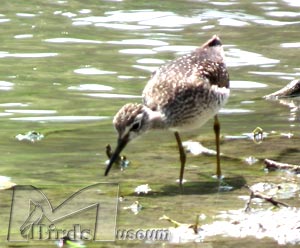 Spotted Sandpiper – Zayandeh Rud – Isfahan
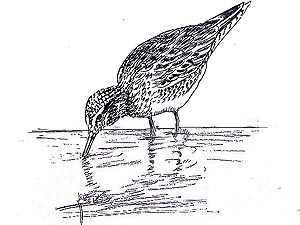 Initial sketch – Sandpiper
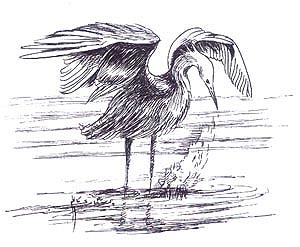 Pencil sketch – Heron
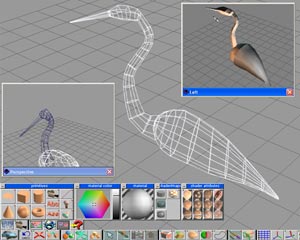 Computer-generated wireframe design
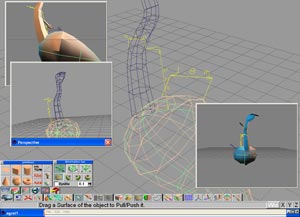 Computer-generated wireframe design
|
|
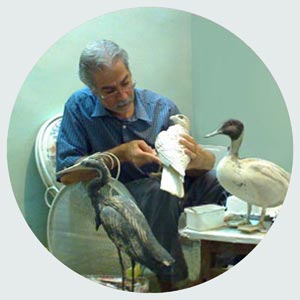
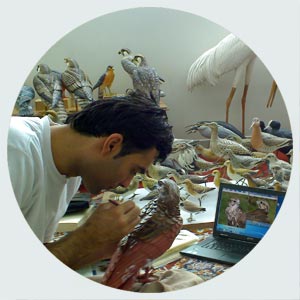
:A Gift from God
To be honest, thanks to much persistence and constant practice, I have now reached a stage where I no longer need all those detailed calculations, computer measurements, formulas, and complex diagrams. I now feel that whatever I observe once, I am capable of constructing its precise model. Time and again, it has become clear to me that the Gracious God bestows a special gift and precious reward upon those who practice diligently, persevere, and place their trust in Him—something that cannot be attained by any other means than practice and perseverance.
There are countless examples of this truth: consider a child learning to walk, or learning to read and write. A beginner, after becoming familiar with the alphabet, must spend quite some time spelling out words, recognizing their movements, and constantly referring back to memory and the teacher’s instructions, just to be able to read or write a few lines—often filled with spelling mistakes. But with repeated practice, he reaches a stage where he can read an entire book fluently, simply by seeing the words, without focusing on the letters one by one, fully grasping the subject without interruption. Or recall the early stages of learning how to drive and compare them with your present ability as a skilled driver: now, without focusing on each command once given by the instructor, you reach your destination swiftly and effortlessly.
If you subtract the first stage from the present stage, what remains is precisely what I have attained today through much practice—nothing less than a valuable gift from the Generous God. This has astonished me time and again. It feels as if my hands directly follow my eyes, without the need for all those mental and geometric calculations—and the remarkable thing is that the outcome seems even more accurate and more beautiful.
Kazem Parastegari
Creator of the Atlas of Birds of Iran and the Middle East
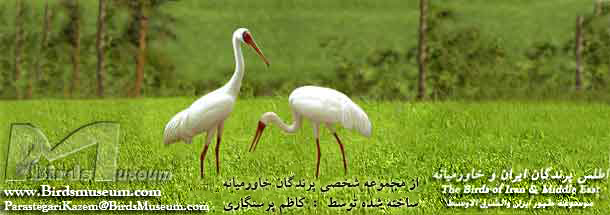
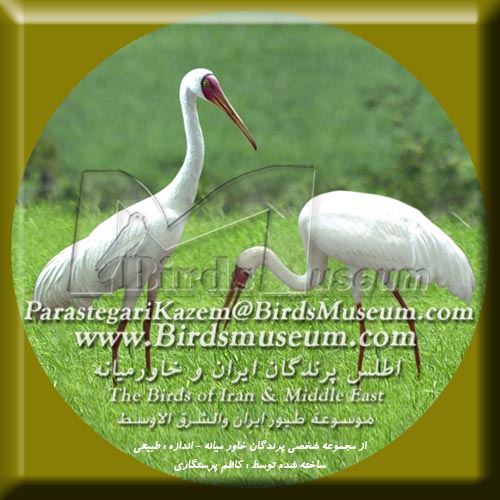
Siberian White Crane – The Birds of Iran and Middle East
 Gallery
 Archive
 Contact-us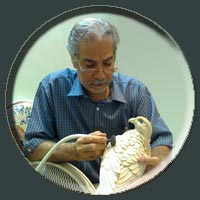

 Home
Home


